The Evolution of P25: Public Safety's Radio Standard
P25 began with a practical interoperability problem. Here's how public safety moved from proprietary systems to shared digital standards — and what that means for agencies today.
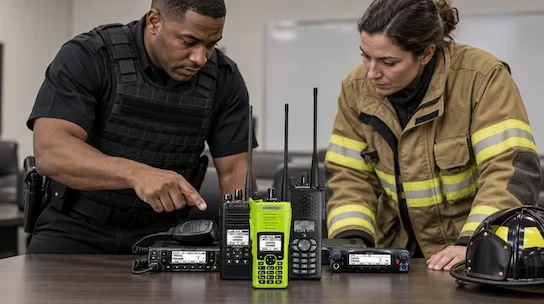
P25 began with a practical public-safety problem: radios from different agencies and manufacturers could not reliably communicate with one another. Many manufacturers used proprietary formats, and once an agency had chosen a system, replacing it meant replacing the whole fleet. The response was a user-driven set of open standards intended to improve interoperability, support competition, and make mission-critical communications more predictable.
Today, Project 25 (P25) remains an evolving suite of land mobile radio standards. Its history explains how public safety moved from proprietary systems toward shared interfaces, more efficient digital voice, and equipment tested against defined requirements.
P25 began with an interoperability problem
In September 1989, APCO, the Association of Public-Safety Communications Officials International, convened with the National Association of State Technology Directors (NASTD) and federal agencies to address incompatibility between public-safety radio systems. The Project 25 Steering Committee formed in 1990 under the APCO/NASTD/FED agreement.
The goal was not simply to select one manufacturer's system. Public-safety users wanted communications standards shaped by their operational needs, with common interfaces that could support equipment from different suppliers.
In 1992, APCO/NASTD/FED and the Telecommunications Industry Association (TIA) entered into a memorandum of understanding for the standards work. TIA's TR-8 engineering committee develops and maintains the technical documents. The P25 standards are published in the TIA-102 series.
In plain terms:
- Public-safety users help identify needs and priorities.
- Industry and users contribute to the standards-development process.
- TIA publishes the technical standards that define system interfaces and functions.
The APCO overview of P25's organization explains how the steering committee, user groups, and TIA work together.
The Common Air Interface: a shared foundation
P25's central promise is a Common Air Interface (CAI): a defined radio interface that allows compatible equipment from different manufacturers to communicate over a shared P25 network.
A common interface matters because interoperability should not depend solely on a single proprietary product family. Agencies can specify equipment against published requirements and evaluate how it fits their network, operational procedures, and procurement standards.
The standard creates the technical foundation. It does not make every radio automatically compatible with every system. Interoperability still depends on factors such as supported features, frequency band, programming, encryption keys, system configuration, and agency agreements.
Phase 1: digital voice on a 12.5 kHz channel
P25 Phase 1 established the original digital P25 air interface. It uses 12.5 kHz FDMA and the IMBE (Improved Multi-Band Excitation) vocoder for digital voice.
FDMA means Frequency Division Multiple Access. In this design, a transmission occupies the assigned channel while the user is speaking. Phase 1 supports conventional and trunked P25 systems.

How FDMA works. Each voice path occupies its own RF channel at 12.5 kHz or 6.25 kHz. Separate conversations are divided by frequency, not by time. NXDN and P25 Phase 1 are FDMA formats.
Many radios also support analog operation for transition or operational needs. Analog is not a P25 digital mode, however. Whether a radio can operate in analog and how it does so depends on the equipment and system design.
Phase 2: two voice paths in one channel
P25 Phase 2 was developed to increase spectrum efficiency on trunked systems. It uses two-slot TDMA, Time Division Multiple Access, to carry two voice paths in the same 12.5 kHz RF channel.

How TDMA works. Both voice paths share the same 12.5 kHz channel, alternating between two time slots. The talker is divided in time, not frequency. DMR and P25 Phase 2 are TDMA formats.
In practical terms, Phase 2 can provide twice the voice-path capacity of a single-slot transmission in that channel. This is often described as 6.25 kHz-equivalent efficiency. Phase 2 uses the AMBE+2 vocoder for its half-rate voice traffic.
Phase 2 supplements rather than erases Phase 1. Systems and radios designed for both can support a staged transition and mixed Phase 1 and Phase 2 operation. Compatibility depends on the specific infrastructure, subscriber radios, and configuration; the label "P25" by itself does not confirm a particular feature set.
Encryption and sensitive communications
P25 defines standardized encryption options for agencies that need to protect sensitive voice or data. AES (Advanced Encryption Standard) is a commonly specified modern option. Legacy DES may also appear in existing systems.
Encryption requires more than choosing a setting on a radio. Agencies need compatible equipment, approved key-management practices, correct key loading, and operating procedures. Encryption also does not replace access control, dispatch protocols, or policy decisions.
Interoperability in the field
P25 is designed to support communications across agencies and jurisdictions. During mutual aid, a shared incident channel or interoperable talkgroup can help dispatch, police, fire, EMS, and emergency management personnel coordinate on a common operational channel.
The standard helps make that coordination technically possible. Planning and training make it usable. Agencies need to confirm that radios are programmed correctly, channels and talkgroups are agreed upon, and encryption settings align. A joint exercise is a practical way to identify gaps before an incident.
A complete communications plan also includes failure drills. Practice with employees and responders should include a scenario such as high winds damaging an antenna, then rehearsing a switch to direct-channel communication. Two-way radio is the coordination core for dispatch, field crews, drivers, and technicians; cellular can provide a supporting path, but cellular networks are not designed to handle unlimited simultaneous call volume from a small area during a disaster or active-shooter event.
P25 CAP: why compliance evidence matters
The P25 Compliance Assessment Program (P25 CAP) is a voluntary testing program administered by the U.S. Department of Homeland Security. It provides a process for suppliers to submit equipment test results and compliance documentation. Testing is conducted by DHS-recognized laboratories, and DHS publishes equipment listings with supporting documentation.
The key procurement point is to check what was actually tested. P25 CAP results apply to specific requirements and features identified in the test reports. A broad claim that equipment is "P25 compliant" is not a substitute for reviewing the applicable test evidence.
Before issuing a bid or approving a purchase, an agency should:
- Identify the P25 features and interfaces the project requires.
- Check the DHS P25 CAP equipment information and its supporting reports.
- Confirm that the proposed equipment matches the system, operating bands, and required functions.
- Include programming, installation, training, service, and lifecycle support in the project scope.
Lowest initial cost is only one part of a radio procurement decision. Equipment that does not meet the system requirements, support the required features, or fit the agency's service plan can lead to avoidable replacements and integration work.
A complete specification should describe the operating environment, interoperability requirements, accessories, installation, maintenance, and support expectations. It should also address radio licensing and frequency coordination where required. Licensing should be handled correctly regardless of how actively a requirement is enforced.
How P25 continues to evolve
P25 is a standards suite, not a frozen product specification. TIA's work continues through updates to interfaces, system functions, security, and related requirements. Agencies must consider how a system will be maintained and supported over its service life, not only which radios are purchased at the start.
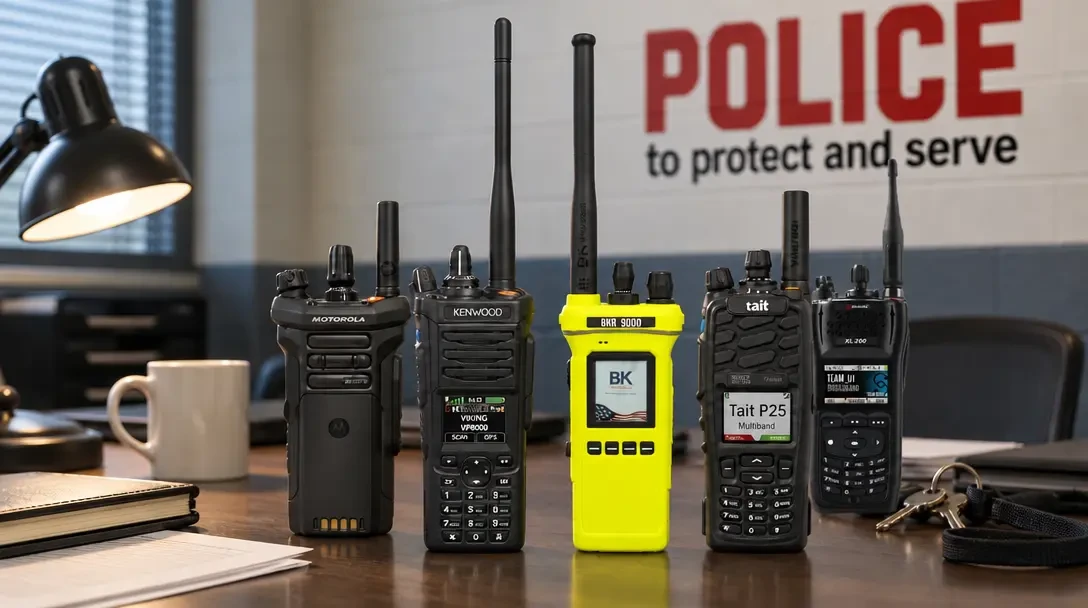
Radio platforms have also become more capable across frequency bands and protocols. The KENWOOD Viking VP8000 is a multiband portable that covers a wide range of protocols and modes in one radio:
- Analog
- P25 Conventional
- P25 Phase 1
- P25 Phase 2
- NXDN
- DMR
- Viking 16, a legacy mode built for compatibility with older Motorola SmartNet and SmartZone trunked systems, which matters to agencies still winding down that equipment
Viking VM models provide mobile options. A multiband, multi-protocol device can support an agency's operational requirements across more than one system, but does not remove the need to confirm configuration and interoperability.
Kenwood, Viking, and EFJohnson: three names, different roles
The names can be confusing:
- Kenwood is the commercial brand associated with NX-series radios, NXDN, and business-radio products.
- Viking is the public-safety product line branded KENWOOD Viking, including the VP8000 multiband portable and VM mobile radios.
- EFJohnson Technologies was acquired by JVCKENWOOD in 2014 and operates as a JVCKENWOOD subsidiary. In April 2025, it was realigned as JVCKENWOOD's P25 Centre of Excellence, focused on KENWOOD Viking radios, ATLAS P25 systems, and KAIROS infrastructure.
In short, one parent company has three names doing different jobs. The product-line name alone does not define which standards or features a specific model supports. Verify the model documentation and project requirements.
Grants and P25 procurement
Some federal and state public-safety grant programs favor or require P25 equipment or particular compliance evidence. Requirements vary by program, funding year, applicant, and project. Confirm eligibility and equipment requirements directly with the funding agency before relying on a grant. P25 CAP listing does not guarantee grant eligibility or funding.
P25 support in the Mid-South
P25 is a public-safety communications category. Comserv supports public-safety programs in the Mid-South through equipment sales, programming, installation, and service. Our team brings more than 150 years of combined experience. Support can include procurement planning, bid specifications, system integration, and ongoing maintenance.
For an agency assessing a radio refresh or new system, a technical consultation can help identify the required standards, equipment interfaces, coverage needs, and service plan. Learn more about Comserv's public-safety communications support and installation services.
Comserv does not provide legal advice or set agency policy. Agencies should consult their appropriate legal, procurement, grant, and licensing authorities.
Call 901-767-6800 or 1-800-795-5102.
Quick Answers
Common Questions
Explore Topics
Written by
Ken Hunt
Content creator and writer sharing insights and stories.