
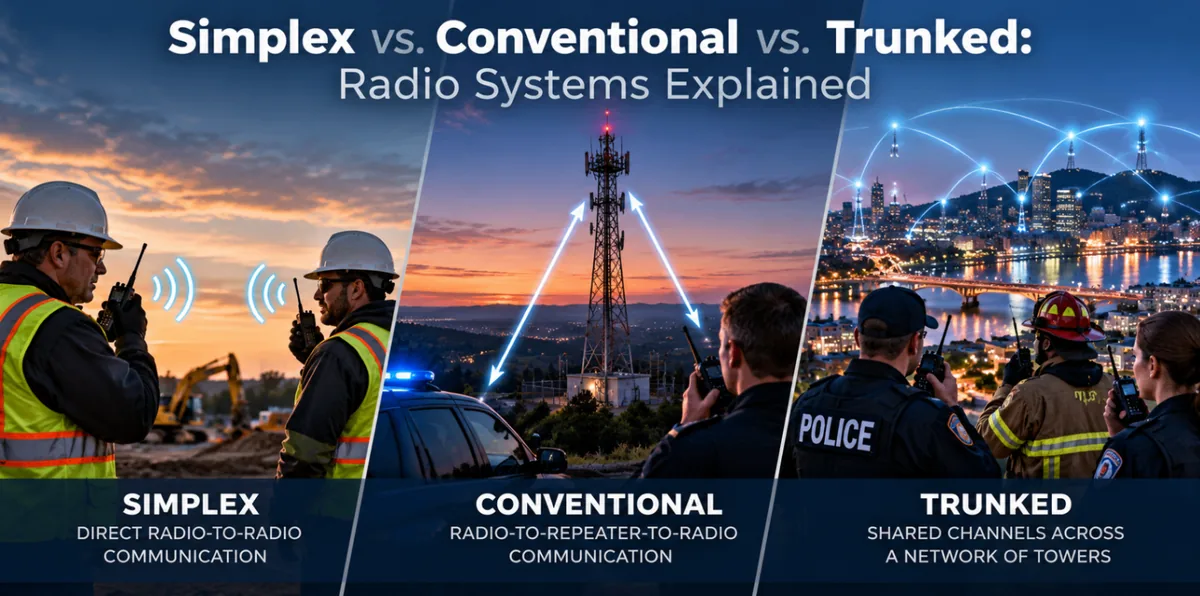
Reliable communications start with the right system architecture. The best fit depends on how far your team needs to communicate, how many conversations happen at once, and how much infrastructure your organization needs to manage.
Simplex, conventional repeater, and trunked systems solve different problems. They serve public safety agencies, schools, industrial crews, warehouses, commercial fleets, casinos, and event teams. Understanding the difference helps you plan a system that works on an ordinary shift, and when conditions get difficult.
At a Glance
- Simplex: Radios communicate directly with one another. No repeater is required.
- Conventional repeater: Users select a channel. A fixed repeater extends coverage.
- Trunked: A controller assigns available channels or time slots to calls as needed.
Digital technology does not automatically mean trunking. A system can be digital and conventional, or digital and trunked.
1. Simplex: Direct Radio-to-Radio Communication
In simplex operation, radios transmit and receive on the same channel. A receiving radio must be within usable range of the transmitting radio. There is no repeater or central controller to extend the signal.
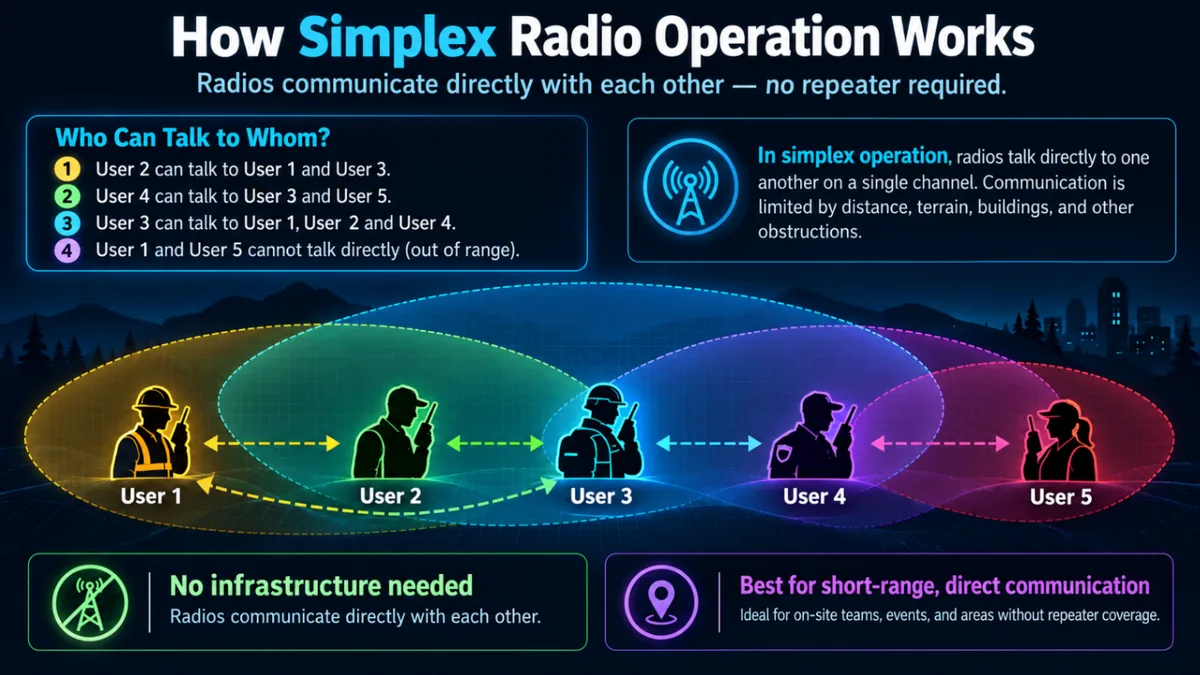
Simplex is a practical choice for:
- A school team working on one campus.
- A warehouse crew coordinating in a defined area.
- An event team managing short-range tasks.
- A field crew needing a direct channel away from its usual repeater coverage.
Range depends on more than the radio. Terrain, buildings, antenna placement, radio power, and obstructions all affect communication. Elevation can improve line of sight, but it does not turn simplex into a repeater system.
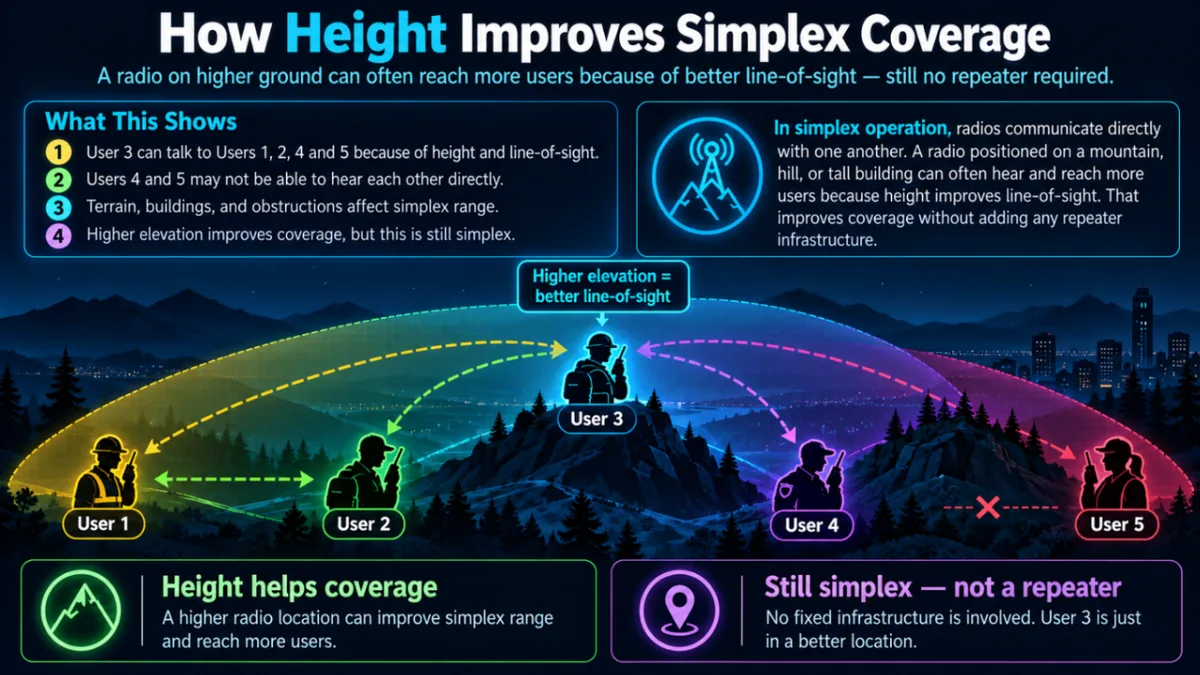
Simplex can also serve as a useful fallback when it is programmed and practiced in advance. It is not an automatic backup: employees need to know which direct channel to use and when to switch.
2. Conventional Repeaters: A Selected Channel With Extended Coverage
A conventional system gives users one or more assigned channels. On a repeater channel, the radios send a signal to a fixed repeater, which retransmits it over a wider area. Users select the channel; the system does not automatically assign them a different channel when traffic increases.
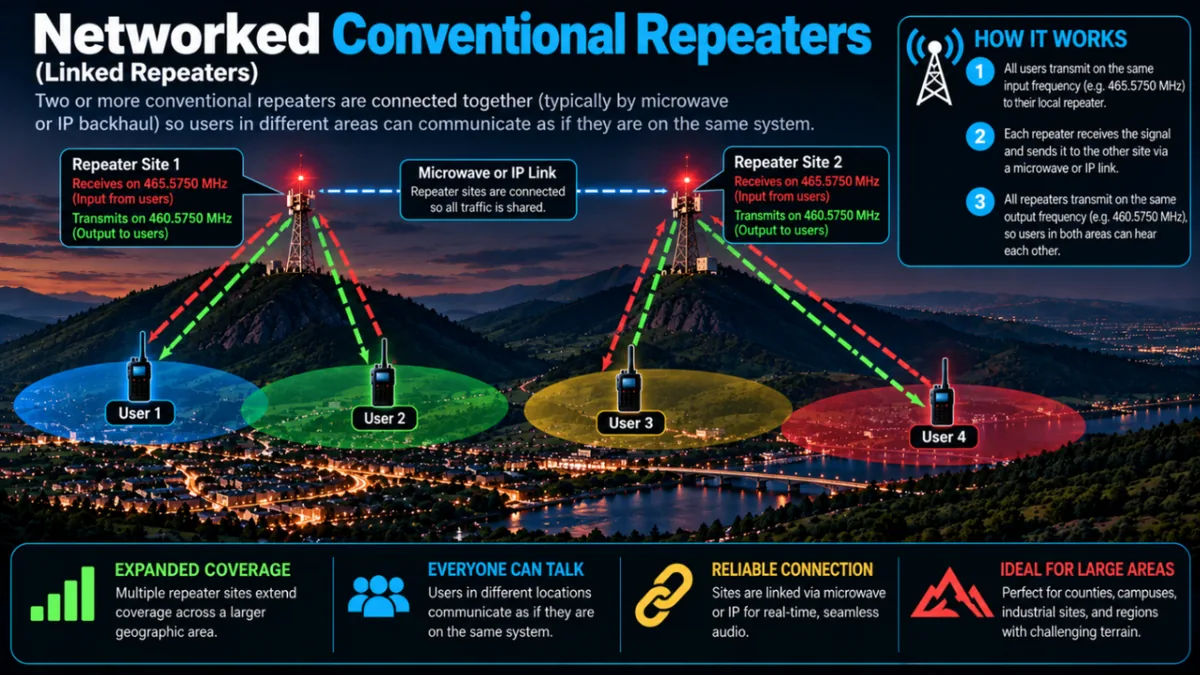
For example, a repeater may receive on 465.5750 MHz and retransmit on 460.5750 MHz. That is an illustrative UHF business-band pair. Actual frequencies must be coordinated, licensed, and programmed for the specific system.
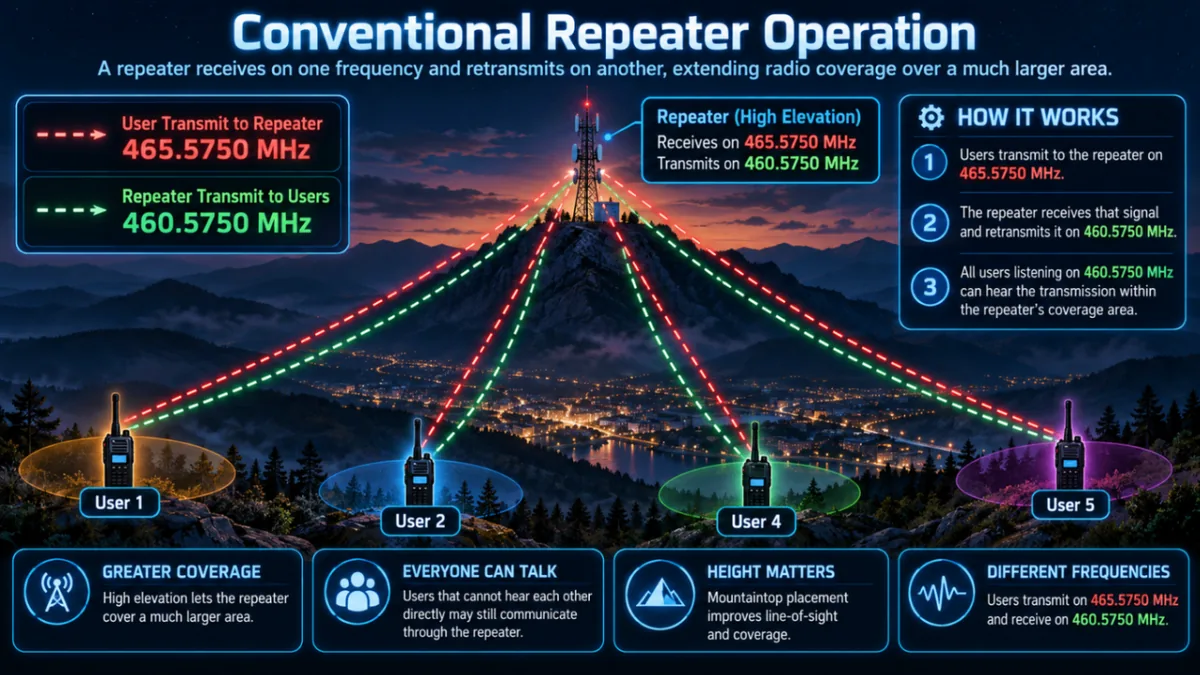
A conventional system is often a good fit when an organization wants predictable channel groups and a defined coverage area. It can be simple to operate and maintain. But users on a busy channel may have to wait for an ongoing transmission to finish.
Capacity depends on the channel plan and technology. A typical analog or FDMA channel supports one conversation at a time. DMR conventional operation can provide two time slots in a 12.5 kHz channel, depending on the system configuration.
Linked Conventional Repeaters
Conventional repeaters can be linked over microwave or IP backhaul. Linking lets audio received at one site reach radios served by another. It expands coverage, but it does not, by itself, make the system trunked. Users may still need to select the right channel or site, depending on the design.
For campuses, industrial sites, and regional operations, the design may also include in-building coverage, dispatch consoles, and other integrated communications systems. A coverage assessment helps identify where additional sites, antennas, or indoor equipment are needed.
3. Trunked Systems: Shared Channels Assigned as Needed
A trunked system manages a pool of radio resources. When a user requests a call, the controller assigns an available channel or time slot. That resource returns to the pool when the call ends.
Think of a bank. A conventional system is like one line served by one teller: if that teller is busy, the next customer waits. A trunked system is like one queue served by several tellers. The next available resource can handle the next call.
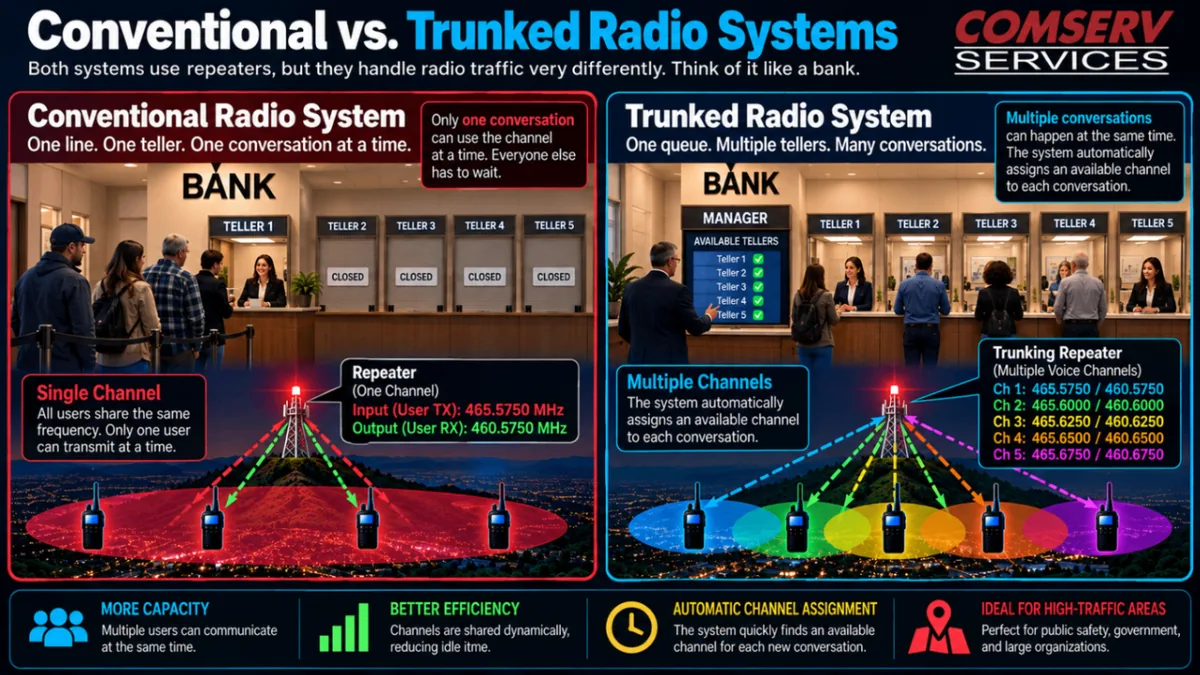
Trunking can improve how a group shares a limited set of channels. It does not create unlimited capacity. System designers must account for the number of users, call patterns, coverage areas, priorities, and peak traffic. Public safety agencies, busy schools, casinos, and large industrial operations may benefit when multiple work groups need access to shared resources.
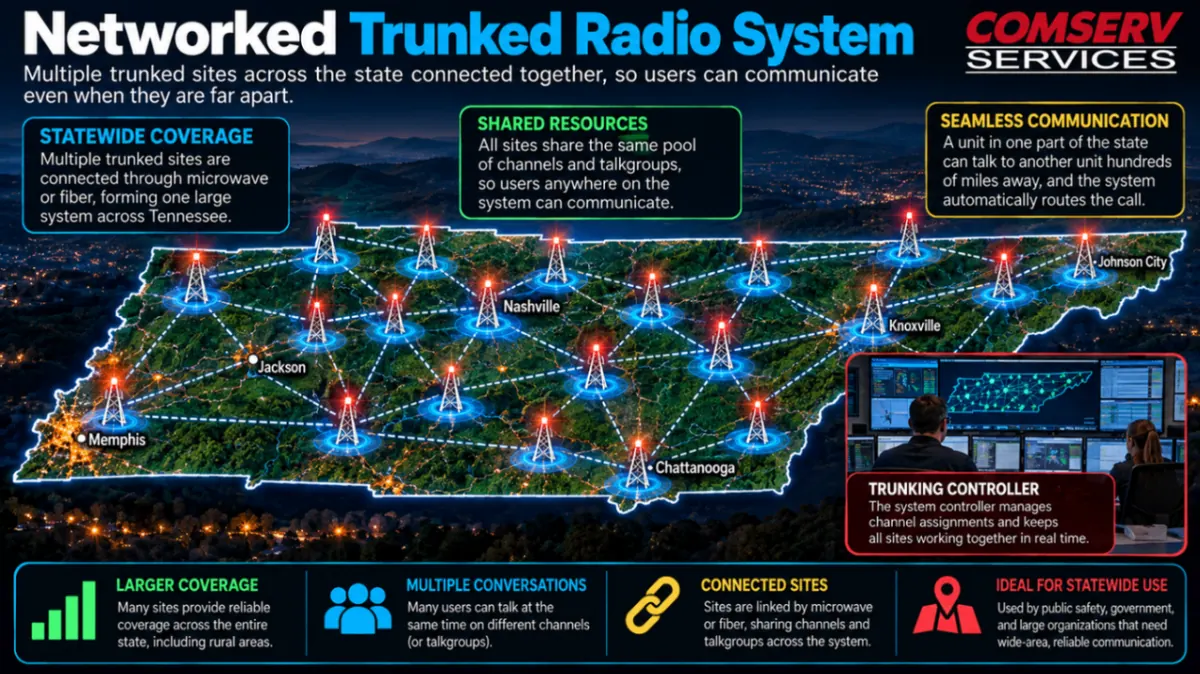
Multi-site trunking can connect sites over microwave or fiber. A controller coordinates resources across the network, and subscriber radios can operate across configured coverage areas.
Trunking Formats and Digital Options
The right format depends on the system requirements, available spectrum, equipment compatibility, and procurement specifications.
- LTR and PassPort: Legacy distributed-control trunking formats. Evaluate existing equipment and service support carefully before planning an expansion.
- P25 Phase 1: Supports conventional and trunked operation. Public safety procurements often specify P25 equipment and system requirements through bid documents. Compatibility must be verified against the actual specification.
- DMR Tier II and Tier III: Tier II is conventional; Tier III is trunked. DMR uses 12.5 kHz channels with two TDMA time slots. It is not a true 6.25 kHz channel.
- NXDN Type-C and Kenwood NEXEDGE: Centralized trunking options using NXDN signaling. NXDN uses FDMA, including true 6.25 kHz narrowband operation where supported by the equipment and channel plan.
- Viking 16: A legacy mode for Motorola SmartNet/SmartZone compatibility. Confirm the exact system and use case; compatible systems may be uncommon.
These technologies continue to evolve. Comserv Services’ team trains across P25, DMR, NXDN, GPS, and in-building coverage systems so that recommendations account for both current needs and future changes.
How to Choose the Right Architecture
Start with operational requirements, not a radio model.
- Coverage: Do users need room-to-room, campus-wide, or regional communication?
- Simultaneous activity: How often do teams need to talk at the same time?
- Work groups: Do departments need separate channels, shared resources, or both?
- Mobility: Do users move between sites, buildings, or service areas?
- Procurement: Are there bid specifications, interoperability requirements, or grant conditions?
- Ongoing support: Who will program, maintain, and update the system?
A familiar planning-room question is, “How many channels do we need?” The better first question is, “How many conversations need to happen at once, and where?” That answer helps determine whether simplex is sufficient, whether conventional repeaters can meet the coverage need, or whether trunking merits evaluation.
For a system assessment, Comserv Services can review radio coverage, channels, dispatch needs, in-building requirements, and existing equipment. We provide end-to-end support from system design and procurement to installation, maintenance, and service. We work with two-way radio systems, public safety agencies, schools, and organizations across the Mid-South.
Call 901-767-6800 to talk through your coverage and capacity needs, or request a consultation.
Common Questions
Does digital radio mean trunked radio?
No. Digital describes how audio and data are transmitted. Trunking describes how the system assigns shared radio resources. DMR Tier II, for example, is conventional; DMR Tier III is trunked.
Can conventional repeaters cover multiple locations?
Yes. Repeaters can be connected using microwave or IP links. That expands coverage, but the system may still require users to select channels or sites; linked repeaters are not automatically trunked.
Can we connect buildings that are far apart?
Yes. Linked repeaters over IP or microwave can tie separate sites into one system, and multi-site trunking extends the same idea across a wider network. The right approach depends on distance, terrain, and how many users share each site. We have connected campuses miles apart — see our dual-campus school case study for a real example.
Do radio systems still need proper licensing?
Yes. Radio licensing must be handled correctly regardless of the level of FCC enforcement. The authorized frequencies and operating parameters must match the license. Comserv Services does not provide legal advice or set policy; the organization’s compliance officer, safety professionals, or counsel own the final call.